From Club Scorebook to Shared Record
Turn a village cricket scorebook into a searchable shared record, with clear source notes and honest handling of uncertain entries for future club members.
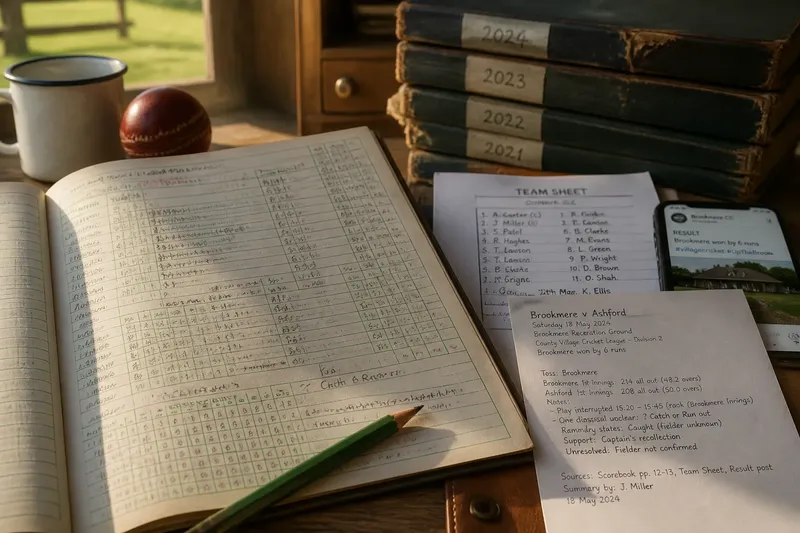
The common mistake with a club scorebook is treating it as a match-day tool that can go straight back on the shelf once the result is known. That can leave the club with a winning total but no clear account of who played, how the innings unfolded or why a later correction was made. A shared scorebook record preserves the original while making the match easier to find and understand.
Imagine a hypothetical village club, Brookmere, whose volunteers have just finished a close Saturday fixture. The scorers’ book holds the running total, a batting card and a few hurried notes; the captain has a team sheet, and a committee member has posted the result online. Several seasons of books sit in a cupboard, but finding one innings means leafing through them and hoping the writing is legible. The club decides to make a match record from those ordinary sources, without pretending every gap can be filled.
A scorebook records more than the final total
The final score answers one question, but a useful record preserves the route to it. A reader may want to know which batters were dismissed, how the overs progressed, who bowled, and whether the innings ended through a declaration, a completed chase or the fall of the final wicket. Those details help the score make sense away from the boundary.
A ground name, opposition, date, competition, toss and team list establish the setting. A brief note might explain that play was interrupted or that a player arrived as a substitute. Such context belongs alongside the figures, not in place of them.
Brookmere asks what someone might need to establish later: who took part, what result was recorded, and where supporting details came from. The club does not add colour simply because a page looks bare. It keeps the distinction between a scored event and a remembered anecdote clear.
Write down the match’s identity before adding commentary.
A consistent filing system makes scorebook records easier to find
Brookmere gives every fixture a predictable home. The paper scorebook remains the original scoring document. A shared digital folder holds a scan or photograph of the completed pages, a readable match summary and any later correction note. File names follow the same pattern: season, date, opponents and ground. Searching then depends less on remembering who happened to score.
The summary does not replace the original. It acts as an index and readable account, while the marked-up book shows what was entered during play. Brookmere records which pages contain the innings and who prepared the summary. For a photograph, the club checks that the writing is in focus, the page edges are visible and glare has not hidden pencil marks.
A folder structure can follow the club’s existing habits: season first, then match date or opponent. Consistency matters more than a clever filing system. A photograph stored only in a volunteer’s phone gallery may be clear today but difficult for the next person to locate.
The club also decides who can add or edit files. Named volunteers maintain the archive, while other members can read it. When responsibility changes, the folder location and filing conventions should pass to the next volunteer along with access.
Uncertainty belongs in the record
At Brookmere, the scorer notices that one batter’s dismissal is difficult to read. The match summary says “caught”, but the mark in the scorebook might indicate a run-out. The captain remembers a catch, though nobody can confirm the fielder. Instead of silently changing the page, the club describes the uncertainty in the summary and leaves the original entry visible.
That choice protects the record’s history. A later reader can see what the scorer wrote at the time and what the club could establish afterwards. If a team sheet, scorer’s note or result card supports a correction, the summary can state the amended detail and name its source. The original page should not be altered to make it appear that the correction was there from the start.
Not every unclear mark needs a detective hunt. A missing detail can remain unknown. Brookmere uses plain wording such as “not recorded in the original book” rather than guessing from memory. The record is more useful when its limits are visible.
If competition rules or equipment instructions affect a record-keeping decision, follow the relevant authority’s guidance rather than inferring a rule from an old scorebook entry.
Questions about building a shared scorebook record?
What should a club transcribe from an old scorebook?
Start with the match identity, result, innings totals and legible batting and bowling details, along with recorded interruptions or unusual endings. Keep a scan of the original pages beside the transcription so readers can distinguish the source from the cleaned-up text.
How should the club handle a disputed score?
Keep the contemporaneous entry and record the disagreement, the people consulted and any supporting document. If the club cannot resolve it, mark the point as uncertain instead of presenting one recollection as settled fact.
Can a digital summary replace the paper book?
A digital summary can be the easiest way to search and share match details, but Brookmere retains the paper original because it shows the scorer’s entries in their original context. A club can choose another arrangement if it keeps a legible, accessible record and knows which copy is authoritative.
Who should be able to update the shared record?
Give editing responsibility to named volunteers who understand the club’s conventions, and make records readable to the wider membership. When responsibility changes, pass on the folder location, naming pattern and unresolved corrections as well as access.
A worked example shows how one match becomes a readable record
Say Brookmere has a hypothetical match with a scorebook page, a team sheet and a result posted on the club’s usual channel. The page shows two innings totals, but one dismissal is hard to read. The club wants a summary that helps members find the match without presenting an uncertain mark as fact.
- Gather the sources. A volunteer places the scorebook page, team sheet and result post in the match folder. The result is an identifiable set of sources, each kept separate rather than merged into one polished document.
- Record what is legible. The volunteer writes the date, ground, opposition, team names, innings totals and recorded result in the summary. The expected result is a readable account of the match’s established details.
- Mark the unclear dismissal. The volunteer compares the scorebook mark with the team sheet and result post. Neither resolves whether the dismissal was a catch or a run-out, so the summary says the original entry is unclear rather than choosing one.
- Check the transcription. A second volunteer compares the summary against the page image and spots that a surname was misread and a total came from the wrong innings column. The summary is corrected; the original image stays untouched.
- Check access and filing. A committee member opens the files from the club’s shared account and asks another authorised volunteer to locate the match by its file name. If it is difficult to find, the club adjusts the naming pattern before adding the record to its index.
The resulting record gives a future member a findable fixture, a readable score and a clear note about what remains uncertain. It does not claim to settle what the evidence cannot settle.
A short review list catches common record problems
Before filing a match, Brookmere uses a simple review list. Each observation leads to a specific choice, so a volunteer knows whether to correct, annotate or leave a record unchanged.
- Check that the date, ground and opposition appear in the summary; if any are missing but visible in a source, add them, and if no source supplies them, mark them as unrecorded.
- Check that each innings total matches the original page; if the figures differ, compare the columns and correct the summary, and if the source remains ambiguous, retain the original figure with an uncertainty note.
- Check that batter and bowler names are legible in the scan; if a name is clear, transcribe it, and if it is not, preserve the uncertain spelling rather than guessing.
- Check that a correction has a named supporting source; if one exists, identify it in the summary, and if none exists, record the discrepancy without changing the original entry.
- Check that the scan shows the full page without glare; if it does, file it, and if text or edges are hidden, make a clearer image or keep the limitation noted.
- Check that an authorised second volunteer can open and locate the files; if they can, add the record to the index, and if they cannot, fix the access or naming problem before treating the archive entry as ready.
- Check whether team sheets contain private contact details; if they do, restrict that source and publish only the intended cricket information, and if they do not, store it with the match record according to the club’s access policy.
Old records need care as well as a filing system
Paper books can suffer from damp, fading ink, loose covers and pages that detach from the binding. Brookmere stores its books away from a leaky changing-room window in a dry cupboard. Volunteers handle fragile pages gently and avoid sticking labels over writing. If a book is already damaged, the club can ask a local archive service or conservator for advice before attempting repairs.
Digital files need their own routine. Brookmere keeps another copy in a separate location and checks that files still open. A short archive note explains the folder structure, naming convention and person responsible for access. A backup that nobody can locate is of little help when a device fails or an account changes hands.
Access matters too. A team sheet may contain personal information beyond what belongs in a public match record. The club can share the cricket details it intends to publish while restricting contact information and internal notes. Keeping those materials separate helps prevent an archive project from exposing details gathered for club administration.
Members give the record a life beyond the scorebook
Once Brookmere has a consistent match record, it adds an index searchable by season, opponent, ground and player name. A shared spreadsheet is enough if its columns are clear and someone is responsible for keeping it current. Members can use it to find an innings, check a club milestone or prepare a reunion display, then return to the source page for detail.
People who remember a match can contribute context, but the club labels the source. A note such as “former player’s recollection, added later” tells readers that it was not written by the scorer on the day. Oral memory can enrich the record without being confused with the scorebook.
Brookmere’s approach leaves three useful layers: the original book, a readable match summary and an index pointing to both. For a club building a scorebook archive, the sensible starting point is one fixture prepared carefully from the evidence already in hand. A consistent shared scorebook record begins with a page someone else can find and understand.